
A product deadline is getting closer, the backlog keeps growing, and your current developers are already stretched. You need more capacity, but deciding how to add it is not always straightforward. Should you hire a permanent employee, or bring in an experienced specialist for a defined period?
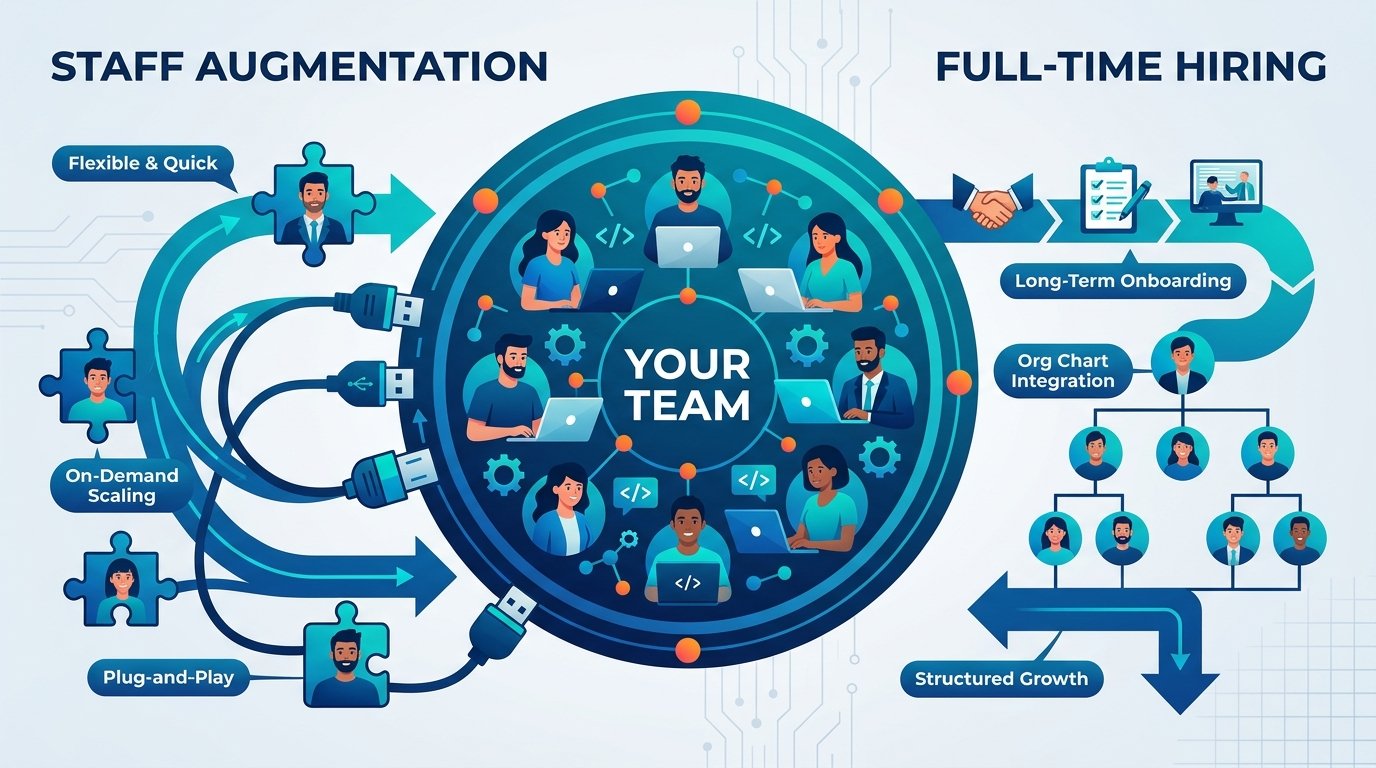
For growing technology companies, the choice often comes down to staff augmentation vs. full-time hiring. Both can work well, but they solve different problems. The right option depends on how long you need the skills, how much control you want to retain, and whether the role is central to your long-term business.
This guide breaks down the practical differences so you can make a decision based on your team’s real needs rather than following a one-size-fits-all hiring rule.
What Is Staff Augmentation?
Staff augmentation means adding external professionals to your existing team for a particular project, skill gap, or period of increased demand. These specialists work alongside your employees and help you move work forward without necessarily creating a permanent position.
For example, a SaaS company might bring in a cloud engineer to support a migration, a QA specialist before a major release, or an AI/ML developer to help test a new feature. Your internal team still sets priorities and owns the product direction; the additional professional contributes the expertise or capacity that is missing.
If you are considering this model, explore Recruiting Simple’s staffing and recruiting solutions to understand how external recruitment support may fit your team’s requirements.
What Is Full-Time Hiring?
Full-time hiring is the process of bringing an employee into your organisation on an ongoing basis. It is often the better fit when the work is continuous, the role carries long-term ownership, or the person needs to build deep knowledge of your product, customers, and internal processes.
A permanent hire can become an important part of your company’s culture and development plans. However, the process may take time: you need to define the role, attract candidates, assess technical and interpersonal skills, agree on compensation, and support onboarding. The cost also extends beyond salary to benefits, equipment, management time, and professional development.
Staff Augmentation vs. Full-Time Hiring: The Main Differences
1. Speed and access to skills
When a deadline is close, waiting for a lengthy hiring process may not be realistic. Staff augmentation can help you access a specialist for a specific need, provided a suitable professional is available and the onboarding requirements are clear. Full-time hiring usually makes more sense when you can invest time in finding the right long-term fit.
2. Cost and commitment
Neither option is automatically cheaper. A contractor or augmented specialist may have a higher hourly rate, while a permanent employee brings ongoing salary and employment costs. Compare the total cost for the period you need, including recruitment, onboarding, benefits, equipment, management, and the cost of delays. A short project may favour temporary support; a permanent workload may justify a full-time role.
3. Control and team integration
With staff augmentation, external specialists generally join your workflows while your business retains day-to-day direction. This can work well when you already have a capable product manager or technical lead. Permanent employees may have more opportunity to develop long-term relationships, retain institutional knowledge, and take ownership of work that evolves over time.
4. Flexibility
Project demand rarely stays constant. You may need extra developers during a product launch but less support after release. Staff augmentation can give you flexibility to scale capacity around those peaks, subject to contract terms and availability. Full-time employees provide continuity, but a business should be confident that the role will remain useful beyond one immediate project.
5. Knowledge retention and continuity
Permanent team members often build up context that is hard to document: why a system was designed a certain way, what customers have requested, and which technical trade-offs have already been made. External specialists can also contribute effectively, but your team should plan documentation, code reviews, handovers, and access management from the start.
When Does Staff Augmentation Make More Sense?
Staff augmentation may be a good fit when:
- You have a defined project or deadline and need additional capacity.
- Your team is missing a specialised skill, such as cloud infrastructure, cybersecurity, data engineering, or AI/ML.
- You want to test a new initiative before committing to a permanent role.
- Your internal leads can manage work and integrate an external professional into existing processes.
- Demand is likely to rise and fall across product milestones.
The model works best when the scope, responsibilities, communication routines, and definition of success are clear. Before anyone starts, agree on access permissions, confidentiality, code ownership, documentation standards, and how progress will be reviewed.
When Is Full-Time Hiring the Better Choice?
A permanent employee may be the stronger option when:
- The workload is ongoing and central to your product or business operations.
- The role requires deep knowledge of customers, systems, or company-specific processes.
- You need someone to develop into a team lead or own a function over time.
- You have the budget and management capacity to support a long-term employee.
- Continuity, mentoring, and internal career development are priorities.
Full-time hiring is not just about filling a seat. It is an investment in the capabilities your company expects to need consistently over the next few years.
A Simple Way to Make the Decision
Before opening a vacancy or contacting a staffing partner, answer these five questions:
- How long will we need this skill: weeks, months, or indefinitely?
- Is the work clearly defined, or will the role evolve as the business grows?
- Do we have an internal person who can guide the work and review quality?
- What is the full cost of each option over the period we need?
- How much product knowledge and continuity will this role require?
If the need is specialised, time-bound, and supported by an internal lead, staff augmentation may be a practical choice. If the role is ongoing and carries long-term ownership, a full-time hire may be more suitable. Some companies use both: a permanent core team supported by external specialists when demand or technical requirements change.
How to Reduce Risk With Either Model
Whichever route you choose, start with a clear role brief. Describe the outcomes you need, the skills that are essential, the tools the person will use, and the people they will work with. Avoid relying on a long list of buzzwords; practical examples of the work are more useful.
Use a consistent evaluation process. For technical roles, combine structured interviews with a relevant skills assessment, and make sure the assessment reflects real work rather than unpaid production tasks. Check references where appropriate, and agree on measurable goals for the first few weeks.
For external specialists, plan a proper onboarding process instead of assuming they can be productive immediately. Provide access to the right documentation, explain decision-making responsibilities, and schedule regular check-ins. For permanent employees, onboarding should also introduce the company’s culture, product strategy, and development opportunities.
If you need help comparing recruitment options, you can review Recruiting Simple’s recruitment services or learn more about the company’s approach on the Recruiting Simple homepage.
Frequently Asked Questions
Is staff augmentation the same as outsourcing?
Not exactly. With staff augmentation, external professionals typically work as an extension of your existing team under your day-to-day direction. Outsourcing more often means handing responsibility for a defined service or deliverable to an outside provider, although arrangements can overlap.
Is staff augmentation only for large companies?
No. Startups and small businesses can use it when they need specialist expertise or extra capacity but are not ready to create a permanent role. The key is to define the scope and make sure the cost fits the project.
Can staff augmentation lead to a permanent hire?
Sometimes, depending on the provider’s terms, local employment rules, and the agreement with the professional. Discuss conversion terms upfront rather than assuming a temporary arrangement can automatically become permanent.
Which option is better for a startup?
It depends on the stage and the work. A startup validating a product or filling a short-term skills gap may value flexibility. A startup building its core product and needing consistent ownership may benefit from permanent employees. Many teams combine the two approaches.
How do we compare the true cost?
Calculate the expected cost across the same time period. Include salary or contract fees, benefits, recruitment, onboarding, equipment, management time, and the potential cost of delayed delivery. Also consider continuity and the value of retaining knowledge.
Conclusion
Choosing between staff augmentation and full-time hiring is less about deciding which model is universally better and more about matching the hiring approach to the work in front of you. Temporary skill gaps, project peaks, and specialist needs can make staff augmentation useful. Ongoing responsibilities and long-term ownership often point towards a permanent hire.
Start with the outcome you need, the length of the commitment, and the capacity already available inside your team. When those details are clear, the decision becomes easier to explain, budget for, and manage.
For growing technology teams, a thoughtful mix of permanent employees and external specialists can provide both continuity and flexibility. The goal is not simply to hire faster; it is to build the right team for the work your business needs to deliver.