
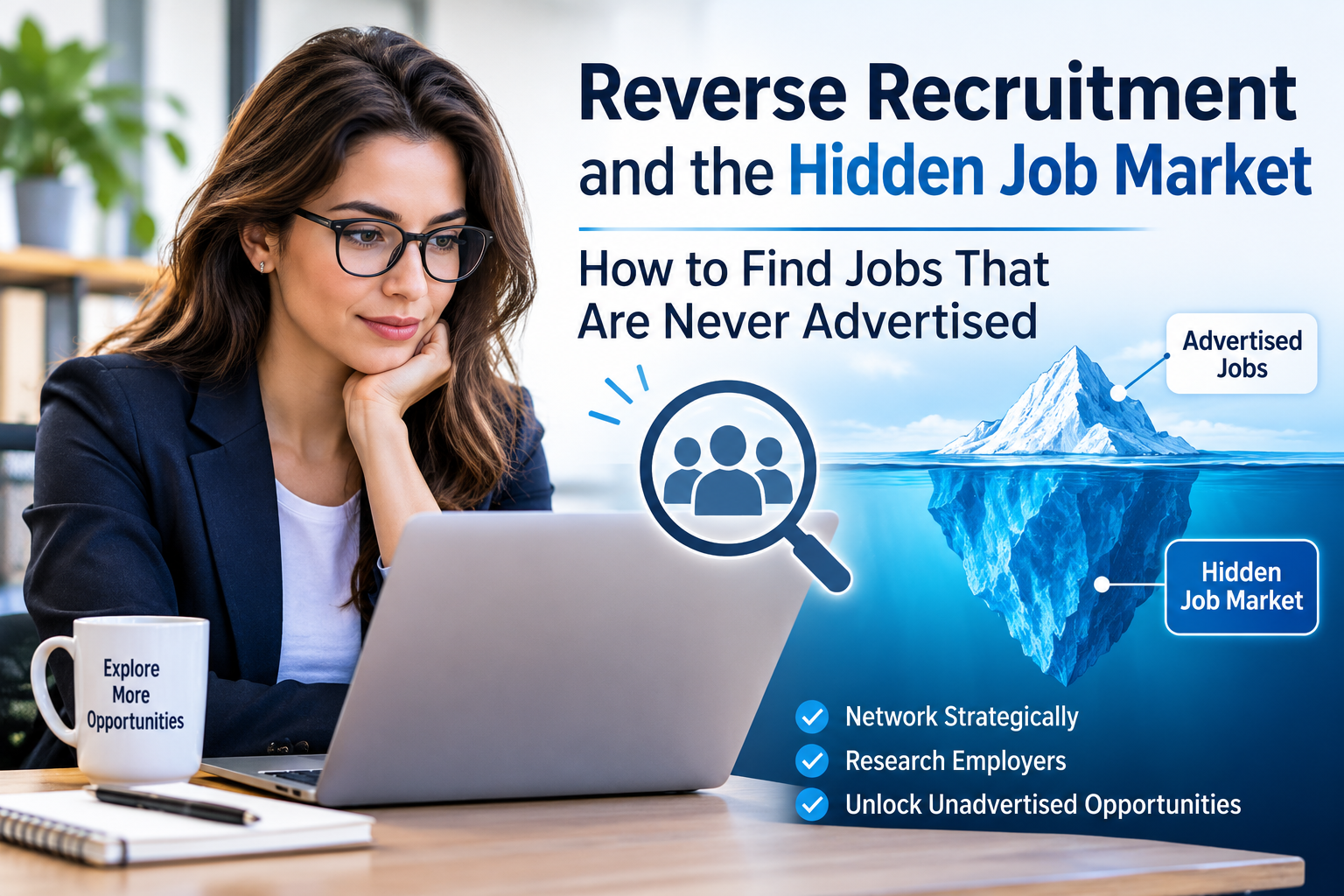
Most job seekers begin their search by visiting job boards, checking company career pages and applying for advertised vacancies. While these platforms provide access to thousands of opportunities, they do not represent every position available in the employment market.
Some employers identify potential candidates through professional networks, referrals, direct enquiries and existing talent pools before publishing a vacancy. Others may be planning to expand their teams but have not yet formally announced their recruitment requirements.
These opportunities are often associated with the hidden job market.
For professionals who rely entirely on advertised vacancies, accessing this part of the employment market can be difficult. They may never discover relevant employers or have an opportunity to introduce their experience before a position becomes competitive.
This is where reverse recruitment can offer a different approach. By combining employer research, professional networking, targeted outreach and application support, candidates can explore opportunities beyond traditional job boards.
In this guide, we explain what the hidden job market is, why some vacancies are never publicly advertised and how reverse recruitment can help professionals approach potential employers more strategically.
What Is the Hidden Job Market?
The hidden job market refers to employment opportunities that are not publicly advertised through traditional job boards or recruitment platforms.
These opportunities may arise when organisations:
- Receive referrals from existing employees.
- Identify potential candidates through LinkedIn.
- Recruit through professional networks.
- Contact individuals already known to their recruitment teams.
- Build talent pools for future vacancies.
- Approach suitable professionals before formally advertising a role.
Not every unadvertised opportunity is a confirmed vacancy. Some employers may simply be interested in meeting potential candidates for future requirements.
For job seekers, understanding this market creates another way to explore employment opportunities rather than depending exclusively on public job advertisements.
Why Do Some Employers Never Advertise Their Vacancies?
There are several reasons why organisations may recruit without publishing a traditional job advertisement.
Internal Recruitment and Employee Referrals
Some companies prefer to consider internal candidates or employee referrals before advertising a position externally.
Existing employees may recommend professionals from their networks who have the relevant experience and qualifications.
Time-Sensitive Hiring Requirements
A company may need someone with specialist knowledge quickly. Searching through an established professional network can sometimes help employers identify suitable candidates more efficiently.
Specialist and Senior Positions
For certain senior or highly specialised positions, employers may use executive search firms, professional networks or direct approaches instead of relying entirely on public advertisements.
Confidential Recruitment
Some organisations prefer to keep particular recruitment activities private, especially when hiring for sensitive business functions or replacing an existing senior employee.
Future Workforce Planning
Employers may identify skills they expect to need in the future and maintain relationships with potential candidates before a vacancy becomes available.
Understanding these reasons helps professionals recognise why building relationships with relevant organisations can be valuable.
How Reverse Recruitment Helps Candidates Access the Hidden Job Market
Reverse recruitment takes a candidate-focused approach to job searching. Rather than waiting for suitable vacancies to appear, professionals receive support with identifying employers and exploring relevant opportunities.
The process may include several activities.
Identifying Suitable Organisations
The first step is determining which companies are relevant to your experience and career goals.
For example, an experienced software developer may identify technology companies expanding their engineering teams, while a finance professional may research organisations opening new offices or strengthening their finance departments.
This research creates a focused list of potential employers.
Researching Hiring Requirements
Before contacting an organisation, candidates should understand its business activities, team structure and possible recruitment needs.
Useful research sources include:
- Company websites.
- LinkedIn company pages.
- Leadership announcements.
- Business expansion news.
- Professional industry communities.
- Publicly available career information.
Research does not confirm that a vacancy exists, but it can help identify organisations worth approaching.
Finding Relevant Decision-Makers
A successful introduction depends partly on contacting the appropriate person.
Depending on the organisation and position, relevant contacts may include hiring managers, department heads, internal recruiters or talent acquisition professionals.
A targeted approach is generally more useful than sending the same message to unrelated employees.
Preparing a Professional Introduction
Candidates should explain who they are, what experience they bring and why they are contacting the organisation.
The purpose is to start a relevant professional conversation, not to demand an immediate job offer.
You can learn more about this candidate-focused approach through RecruitingSimple’s reverse recruitment service.
Building an Employer Target List Before Applying
A well-researched employer list can make the job search more organised.
Instead of collecting hundreds of company names, focus on organisations that have a reasonable connection with your professional background.
Define Your Target Industry
Start with the industry in which you have relevant experience or want to develop your career.
For example, a digital marketing professional might research technology companies, eCommerce businesses, digital agencies and organisations investing in online customer acquisition.
Identify Companies of the Right Size
Different organisations have different recruitment structures.
Start-ups may recruit through founders and department leaders, while larger organisations often have dedicated talent acquisition teams.
Understanding company size can help you decide whom to contact.
Review Business Developments
Look for genuine indicators of potential hiring activity, such as:
- New product launches.
- Business expansion.
- New office openings.
- Increased service offerings.
- Department growth.
- Public announcements about new projects.
These developments may suggest changing workforce requirements, although they should not be treated as proof of an open position.
Organise Your Research
Maintain a spreadsheet containing company names, websites, relevant contacts, potential roles, research notes and outreach dates.
This makes it easier to manage follow-ups and avoid contacting the same organisation repeatedly.
Using LinkedIn to Discover Unadvertised Job Opportunities
LinkedIn is useful for professional networking and employer research. It can help candidates understand organisations, identify relevant people and establish professional relationships.
However, finding an opportunity requires more than sending a large number of connection requests.
Search for Relevant Companies
Use LinkedIn’s company search to identify organisations within your target industry and location.
Review their services, employee profiles, company updates and career information.
Identify Hiring Managers and Recruiters
Search for professionals with relevant responsibilities, such as talent acquisition, recruitment, department management or team leadership.
Prioritise people who are connected to the type of position you want.
Follow Company Updates
Company announcements can provide useful information about expansion, new projects and organisational changes.
These updates may help you identify a relevant reason to start a professional conversation.
Build Relationships Before Asking for a Job
Engage with relevant professional discussions and share useful insights where appropriate.
A genuine professional relationship can be more valuable than sending repeated messages asking whether a vacancy is available.
For more information about candidate-focused recruitment, explore the RecruitingSimple blog archive.
How to Contact Employers About Unadvertised Opportunities
Direct employer outreach should be professional, relevant and personalised.
A message that demonstrates an understanding of the organisation is more useful than a generic request for employment.
Write a Relevant Subject Line
For an email introduction, use a clear subject that communicates your professional area.
Examples include:
- Experienced Data Analyst Interested in Future Opportunities.
- Digital Marketing Specialist Exploring Your Team’s Requirements.
- Software Engineer Interested in Your Technology Projects.
Introduce Your Professional Background
Briefly explain your experience, specialist skills and the type of work you are interested in.
Avoid including your entire CV in the first message.
Explain Why You Are Contacting the Organisation
Mention something relevant about the company’s business, industry or activities.
This demonstrates that your message is intentional rather than part of a mass outreach campaign.
Include a Clear Next Step
You can ask whether the organisation would be open to reviewing your CV or discussing potential future requirements.
Keep the request simple and respectful.
Example outreach message:
Subject: Experienced Marketing Professional Interested in Future Opportunities
Hello,
I have been following your company’s work in the digital services sector and wanted to introduce myself.
I have experience in digital marketing, SEO strategy and content optimisation, and I am interested in learning whether my background could be relevant to your current or future team requirements.
I would be happy to share my CV if there is a suitable opportunity to explore.
Kind regards,
[Your Name]
Making Your CV Suitable for the Hidden Job Market
When approaching employers directly, your CV needs to communicate your professional value quickly.
Unlike a formal application, an unsolicited introduction may not be connected to a specific job description. Therefore, your CV should make your expertise and preferred career direction clear.
Create a Strong Professional Summary
Explain your experience, industry knowledge and specialist skills in a few concise sentences.
Avoid vague statements that do not distinguish your professional background.
Highlight Measurable Achievements
Include genuine examples of projects, improvements and results.
For example, a sales professional might describe revenue growth, customer acquisition or account management achievements.
A technical professional might highlight software development projects, system improvements or successful implementations.
Make Your Target Role Clear
Employers should be able to understand which type of opportunity you are interested in.
If your CV covers several unrelated career directions, prepare suitable versions for different professional audiences.
Keep Your Contact Information Updated
Include a professional email address, relevant contact details and a link to your LinkedIn profile or portfolio where appropriate.
For additional guidance, review the complete guide to reverse recruitment.
Why Professional Networking Matters in the Hidden Job Market
Networking can help candidates become familiar to people working in their target industries.
It is not simply about collecting contacts. The objective is to build relationships that support professional knowledge-sharing and career development.
Reconnect With Previous Colleagues
Former colleagues, managers and professional contacts may know about changes in their organisations or upcoming recruitment requirements.
A genuine conversation can help you understand where relevant opportunities may exist.
Attend Industry Events
Conferences, webinars, professional meet-ups and networking events provide opportunities to connect with people in your field.
Participating in relevant discussions can help establish your professional presence.
Join Professional Communities
Industry groups can provide access to useful discussions, learning resources and professional contacts.
Choose communities that are relevant to your experience and career interests.
Maintain Relationships Over Time
Do not contact people only when you need a job.
Share useful information, congratulate professional achievements and maintain appropriate communication.
Long-term professional relationships are often more valuable than one-time requests.
How to Follow Up Without Damaging Your Professional Reputation
Following up can be useful when an employer has not responded to your introduction.
However, repeated messages can create a negative impression.
Allow Reasonable Time for a Response
Give the recipient enough time to review your message. The appropriate waiting period depends on the organisation and the nature of your enquiry.
Keep Your Follow-Up Short
A polite reminder is usually sufficient.
For example:
“Hello, I wanted to follow up on my previous message regarding potential opportunities within your organisation. I would be happy to share further information about my experience if relevant. Thank you for your time.”
Respect the Employer’s Response
If the organisation confirms that there are no suitable opportunities, thank them for their response.
You can ask whether it would be appropriate to stay connected for future requirements.
Avoid sending repeated messages after receiving a clear refusal.
Common Mistakes When Searching for Hidden Job Opportunities
The hidden job market can provide additional ways to explore employment, but candidates should approach it carefully.
Assuming Every Company Has an Open Vacancy
A company may be relevant to your experience without currently recruiting.
Treat employer research as a way to identify potential opportunities, not proof that a position exists.
Sending Generic Messages
Mass outreach often produces poor results because it does not demonstrate an understanding of the recipient or organisation.
Personalise your communication and contact relevant people.
Contacting the Wrong Employees
Sending job enquiries to unrelated employees can waste time and create unnecessary interruptions.
Research the appropriate recruitment or departmental contact first.
Sharing an Unfocused CV
A CV that does not explain your professional strengths or target role may be difficult for employers to evaluate.
Make your experience relevant to the organisations you approach.
Ignoring Advertised Opportunities
The hidden job market should complement traditional job searching rather than replace it.
Continue reviewing relevant job advertisements while developing professional relationships and exploring direct employer outreach.
How to Choose the Right Reverse Recruitment Service
A reverse recruitment provider may help candidates organise employer research, improve applications and manage professional outreach.
Before selecting a service, consider the following factors.
Understand What Is Included
Check whether the service provides career planning, employer research, CV optimisation, LinkedIn improvements, application support and interview preparation.
Ask About Employer Outreach
Understand how potential employers are identified and how introductions are managed.
The provider should explain its approach rather than making vague promises about access to hidden vacancies.
Review Communication and Reporting
Ask how progress will be shared, how target employers will be selected and how outreach activity will be tracked.
Check Pricing and Expectations
Understand the fees, responsibilities and services included before making a commitment.
Avoid providers that guarantee unadvertised jobs, interviews or employment outcomes.
You can learn more about the organisation and its approach on the RecruitingSimple About Us page.
FAQs About Reverse Recruitment and the Hidden Job Market
1. What is the hidden job market?
The hidden job market refers to employment opportunities that are not publicly advertised through traditional job boards. Employers may identify candidates through referrals, professional networks, direct outreach or existing talent pools.
2. Can reverse recruitment help me find unadvertised jobs?
Reverse recruitment can help candidates research suitable employers, identify relevant contacts and explore opportunities beyond public job advertisements. However, it cannot guarantee that an employer has an available vacancy.
3. How do I approach a company that is not advertising jobs?
Research the organisation, identify an appropriate recruitment or departmental contact and send a concise, personalised introduction explaining your experience and interest in potential opportunities.
4. Is LinkedIn useful for finding hidden job opportunities?
Yes. LinkedIn can help professionals research companies, connect with recruiters and hiring managers, follow business developments and build relationships within their industries.
5. Should I send my CV to companies without an advertised vacancy?
You can send a CV when it is appropriate and the organisation accepts unsolicited applications. Make sure your introduction is relevant and explain why your experience may be useful.
6. Are hidden job opportunities better than advertised vacancies?
Not necessarily. An unadvertised opportunity may be suitable, but it still needs to be evaluated against your career goals, salary expectations, responsibilities and employment requirements.
7. Does reverse recruitment guarantee access to the hidden job market?
No. Reverse recruitment can support employer research and targeted outreach, but access to opportunities depends on employer requirements, professional relationships and market conditions.
Conclusion
The traditional job market is only one part of the employment landscape. Some organisations identify potential employees through referrals, professional relationships and direct approaches before publishing a vacancy.
For candidates who rely exclusively on job boards, these opportunities may remain difficult to discover.
Reverse recruitment offers a more structured way to explore the hidden job market through employer research, professional networking, targeted outreach and stronger career positioning.
The most effective approach is to combine these activities with traditional applications rather than depending on one method alone.
If you want to explore opportunities beyond advertised vacancies, discover RecruitingSimple’s reverse recruitment services and learn how a candidate-focused job search strategy can help you approach potential employers more effectively.