
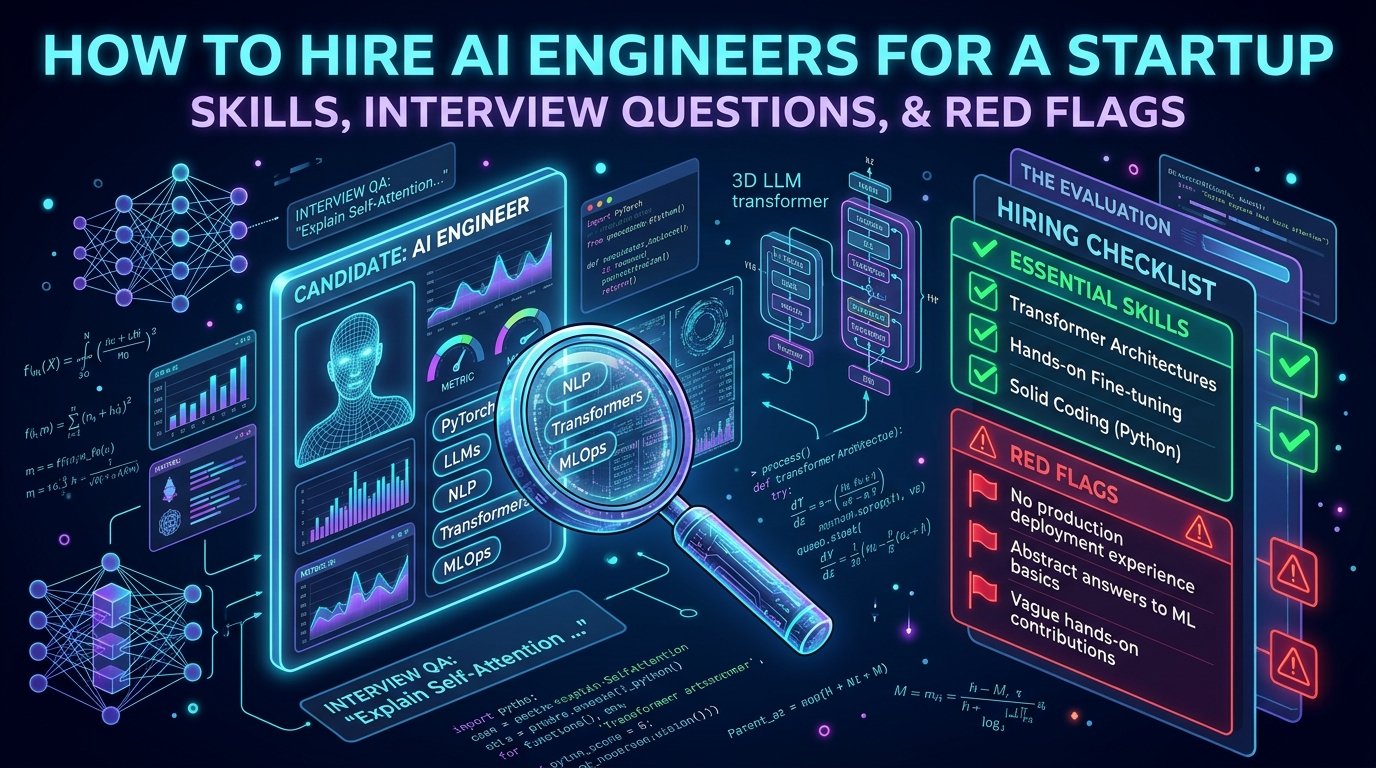
Hiring your first AI engineer can feel different from hiring a typical software developer. You may have a product idea, a growing backlog, and a clear sense that AI could improve what you offer. But once you start reviewing CVs, the process can get confusing. One candidate talks about machine learning models, another focuses on large language models, and a third lists a long collection of AI tools. Which experience will actually help your business?
For a startup, the goal is not to hire the person with the most impressive list of technologies. It is to find someone who understands the problem you need to solve, can work within your current resources, and can turn an idea into something useful and reliable. This guide explains how to hire AI engineers for a startup with a more focused and practical process.
Start With the Problem, Not the Job Title
Before writing a job description, decide what you want the engineer to deliver. Are you building an AI feature into an existing product, automating an internal workflow, developing a recommendation system, or experimenting with a new product concept? Each goal calls for a different mix of skills.
For example, a team adding a chatbot to its customer support platform may need experience with language models, retrieval-augmented generation (RAG), APIs, evaluation, and data privacy. A startup building a forecasting product may need stronger foundations in statistics, data engineering, and traditional machine learning. Hiring for the broad label ‘AI engineer’ without defining the work can attract candidates whose experience does not match your actual needs.
If you are still shaping your hiring plan, review Recruiting Simple’s recruitment approach and hiring process for context on matching recruitment to business requirements.
Which Skills Should You Look For in an AI Engineer?
There is no universal checklist for every AI role. Use the responsibilities of the position to separate essential skills from those that would simply be nice to have.
1. Strong software engineering fundamentals
An AI feature still needs to run inside a real product. Look for sound programming skills, readable code, testing habits, API integration, version control, and an understanding of deployment. A prototype that works once on a laptop is not the same as a feature that can be maintained by a team.
2. Relevant machine learning or generative AI experience
Ask candidates to explain the specific type of AI work they have done. Depending on your project, this could include model selection, prompt design, RAG pipelines, embeddings, fine-tuning, classification, forecasting, or model evaluation. Depth in the right area matters more than familiarity with every new framework.
3. Data handling and evaluation
Useful AI systems depend on suitable data and a reliable way to measure results. Candidates should be able to discuss data quality, privacy, evaluation sets, failure cases, and how they would decide whether a model is performing well enough for release.
4. Product thinking and communication
Startups rarely have perfectly defined requirements. An effective engineer asks clarifying questions, explains trade-offs, and can work with product, design, and business colleagues. They should be comfortable saying when a simpler non-AI solution would be cheaper, faster, or more dependable.
How to Write a Job Description That Attracts the Right People
A long list of tools can make a vacancy look technical without helping candidates understand the role. Instead, explain the product, the problem to solve, the current stage of development, and what success could look like in the first three to six months.
A useful AI engineer job description should cover:
- The business problem and the product or workflow the engineer will support.
- The outcomes expected in the first 90 days.
- The essential technical skills, separated from optional experience.
- The team structure and who will make product and technical decisions.
- The data, infrastructure, budget, and deployment environment available.
- The work arrangement, location or time-zone expectations, and interview stages.
Be honest about the stage of the product. If the role involves early experiments and changing priorities, say so. Clear expectations help candidates assess whether they will enjoy the work and help you avoid mismatches later.
Interview Questions That Reveal Real Experience
A candidate can memorise definitions and still struggle to build a dependable AI feature. Use questions that encourage them to describe decisions, trade-offs, and lessons from actual projects.
Tell us about an AI project you took from an idea to a working release.
Listen for the candidate’s own contribution, the constraints they faced, how they tested the result, and what happened after launch.
How would you decide whether our problem needs AI at all?
A thoughtful candidate should compare an AI approach with simpler options and explain the trade-offs in cost, quality, latency, and maintenance.
How would you evaluate a RAG-based assistant?
Look for a discussion of retrieval quality, answer relevance, groundedness, representative test questions, failure analysis, and ongoing monitoring.
What would you do if the model gave confident but incorrect answers?
The candidate should explore the source of the error and propose measurable safeguards, such as better retrieval, clearer boundaries, validation, or human review where appropriate.
How would you deploy and maintain the feature?
Listen for practical considerations such as testing, monitoring, access controls, versioning, latency, cost, and a way to roll back changes.
Use a Practical Assessment Without Creating Unpaid Work
A short, relevant assessment can help you understand how a candidate thinks. Keep it limited and close to the work they would actually do. For example, ask them to review a small sample dataset, explain an architecture for a feature, or identify weaknesses in a simplified AI workflow.
Share the evaluation criteria in advance and give candidates a reasonable time limit. Avoid asking them to build a production-ready feature for free. During the discussion, ask why they made particular choices and what they would change with more time. The explanation often tells you as much as the final output.
Red Flags to Watch For
- The candidate claims to be an expert in every AI tool but cannot explain a project in detail.
- They focus on model performance without discussing the data, evaluation method, or real-world limitations.
- They promise that AI will solve the problem perfectly without meaningful testing or oversight.
- They overlook privacy, security, data access, or the risks of exposing sensitive information.
- They cannot explain technical trade-offs to a non-technical colleague.
- Their portfolio shows demos but provides no clear account of their personal contribution or how the work was evaluated.
One red flag does not automatically mean a candidate is unsuitable. Use follow-up questions and consistent evaluation criteria to understand whether the concern is genuine.
Should a Startup Hire In-House or Work With a Recruitment Partner?
If your founding team has technical hiring experience and the role is clearly defined, managing the search internally may be practical. But AI roles can be difficult to assess when your team does not have the specialist knowledge to distinguish strong, relevant experience from impressive-sounding terminology.
A recruitment partner may help define the search, reach candidates who are not actively applying, and organise a more focused shortlist. The hiring company should still own the final technical assessment and decision. Before choosing a partner, clarify their understanding of the role, candidate screening process, communication cadence, fees, and what happens if the first shortlist is not suitable.
Recruiting Simple explains its wider hiring support on the recruitment agency page and offers information about hiring a tech recruiter in the USA. These resources can help you think through the support your search may require.
Frequently Asked Questions
When should a startup hire its first AI engineer?
Hire when you can describe a real business problem, identify the data and resources available, and explain how you will measure success. If the idea is still vague, a short discovery phase may be more useful than immediately opening a permanent role.
Does an AI engineer need a PhD?
Not always. Some research-heavy roles require advanced academic expertise, but many applied AI positions place greater emphasis on software engineering, practical model development, evaluation, and deployment. Match qualifications to the work.
What is the difference between an AI engineer and a machine learning engineer?
The titles overlap across companies. AI engineers may focus on integrating AI capabilities into products, including generative AI systems, while machine learning engineers often concentrate on developing, deploying, and maintaining machine learning models and pipelines. Always assess the actual responsibilities rather than relying on the title.
How can a non-technical founder assess an AI candidate?
Use a structured process, ask candidates to explain past projects in plain language, and involve an independent technical reviewer for the deeper assessment. Evaluate how clearly they explain risks, options, and expected outcomes.
Should a startup hire a full-time AI engineer or use a contractor?
It depends on the length and continuity of the work, the skills required, and the budget. A defined experiment may suit temporary specialist support, while an ongoing core product capability may justify a full-time hire. Compare total costs and knowledge-retention needs before deciding.
Conclusion
Hiring an AI engineer is easier when you begin with the problem rather than the hype around the technology. Define the outcome, identify the skills that genuinely matter, and use interviews and practical assessments to understand how candidates make decisions. Look for people who can build, test, explain, and maintain a solution—not simply list familiar AI tools.
For a startup, the right hire should fit both the technical challenge and the way your team works. A focused hiring process gives you a better chance of finding someone who can turn an ambitious idea into a useful product feature without adding avoidable complexity.